



September
San Pedro Cactus: Origin, History, Regulations, and Safety
Updated on October 29, 2026 · Reading time: 11 minutes
Short answer: The San Pedro cactus (Echinopsis pachanoi) is a columnar cactus native to the Andes in Peru and Ecuador. It naturally contains mescaline. Mescaline is listed in Schedule I of the Opium Act. The living cactus itself is not listed and may be sold as an ornamental plant. Any processing intended to extract mescaline is prohibited. We therefore do not provide preparation instructions.
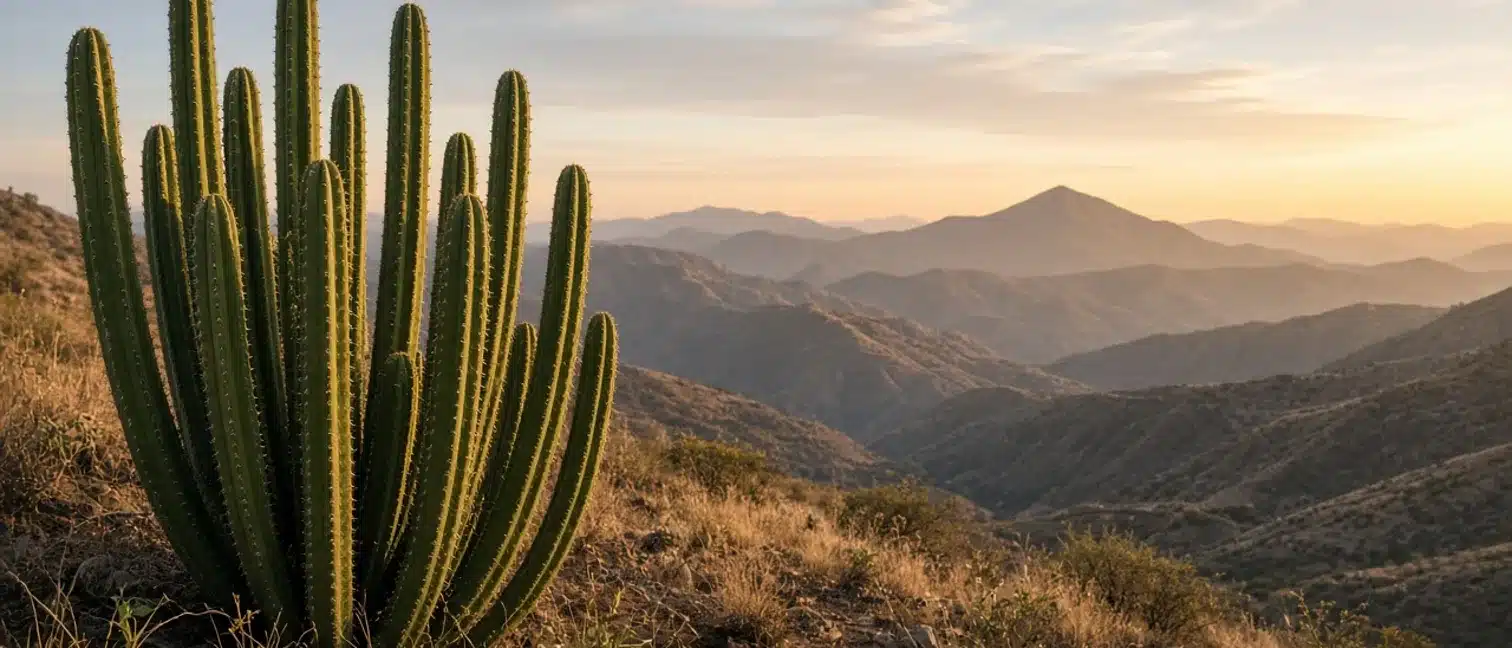
With its tall green columns, the San Pedro is a striking cactus. You’ll find it in garden centers, on windowsills, and in botanical gardens. But the plant also has a long history in the Andes, where it has been used in rituals for thousands of years.
In this article, you’ll learn where the San Pedro comes from, how to identify it, and what role it plays in history. We’ll also discuss mescaline, what Dutch law says about it, and what risks are involved. An important point to note upfront: processing the cactus to extract mescaline is prohibited. That’s why this article does not include any preparation instructions.
Table of Contents
What is the San Pedro cactus?
The San Pedro is a columnar cactus. Its scientific name is Echinopsis pachanoi. In older books and among collectors, you may also see the name Trichocereus pachanoi. The species was described in 1920 by the American botanists Nathaniel Lord Britton and Joseph Nelson Rose. They named it after the Ecuadorian botanist Robert Pachano.
The name San Pedro refers to Saint Peter, the saint with the keys to heaven. According to a common explanation, the cactus was given this name because it is said to open the gateway to another world for users. In Peru, the plant is also known as huachuma or achuma.
Recognition
The San Pedro grows as a cluster of upright, blue-green columns. In the wild, these columns can grow to be three to six meters tall. Each column usually has six to eight ribs. The ribs feature small areoles with short spines. Some specimens have almost no spines. In the summer, the cactus can produce large white flowers that open at night and have a strong fragrance.
Related species
There are related columnar cacti that resemble the San Pedro. The best-known are the Peruvian Torch (Echinopsis peruviana) and the Bolivian Torch (Echinopsis lageniformis). The Peruvian Torch usually has longer spines. The Bolivian Torch is primarily found in Bolivia. These species also contain mescaline. Another well-known mescaline cactus is the small peyote (Lophophora williamsii) from Mexico and Texas.
A Long History
The San Pedro is one of the oldest known plants used in rituals in South America. Archaeologists have found depictions of the cactus on pottery, textiles, and stones from Peru. A well-known example is the temple at Chávin de Huántar in the Peruvian Andes. There is a stone relief there depicting a figure holding a columnar cactus. That temple was built around 1200 B.C. and has been a UNESCO World Heritage Site since 1985.
Researchers also found remains of San Pedro in a cave in Peru that were dated using radiocarbon. Those remains are thousands of years old. This makes the use of the cactus one of the oldest known traditions on the continent.
After the Spanish conquest
After the arrival of the Spanish in the sixteenth century, the Catholic Church attempted to suppress the use of the cactus. However, it did not disappear. Its use became intertwined with Christian elements. This gave rise to the tradition of the curanderos, healers who continue to practice in northern Peru to this day. Their ceremonies combine the cactus with prayers, statues of saints, and music.
For curanderos in northern Peru, San Pedro is not a recreational substance. It is part of a centuries-old tradition with its own rules and significance.
Mescaline
The active ingredient in San Pedro is mescaline. It is an alkaloid belonging to the phenethylamine group. The German chemist Arthur Heffter isolated mescaline from peyote in 1897. In 1919, the Austrian chemist Ernst Späth first synthesized the substance. Mescaline is a classic psychedelic that acts on the serotonin 2A receptor in the brain.
The British writer Aldous Huxley described his experience with mescaline in 1954 in the book *The Doors of Perception*. That book had a major influence on the counterculture of the 1960s. The rock band The Doors even took its name from it.
How much mescaline is in it?
The mescaline content varies greatly from plant to plant. It depends on the species, age, growing location, and season. Research on San Pedro shows values that can differ by a factor of tens. You cannot tell by looking at the outside of a cactus how much mescaline it contains. That makes its use unpredictable.
What does the law say?
In the Netherlands, mescaline is listed on Schedule I of the Opium Act. This is the list of hard drugs. The possession, preparation, sale, transportation, and import and export of mescaline are prohibited. The San Pedro cactus itself is not listed. Therefore, the living plant may be sold as an ornamental plant and kept in the home.
However, once the cactus is processed for the purpose of using the mescaline—such as by drying, grinding, boiling, or extracting it—that may be a criminal offense. The resulting product is then considered a mescaline-containing substance and falls under Schedule I. The sale of dried or chopped San Pedro as a product intended for use is also prohibited.
Be careful when traveling abroad Different rules apply in many countries. In some countries, the cactus itself is banned. In others, only mescaline is illegal. Always check the laws of the country where you are or where you are traveling.
Risks
The use of mescaline is not without risk. The Trimbos Institute and Jellinek list symptoms such as nausea and vomiting, a faster heart rate, higher blood pressure, sweating, and restlessness. A mescaline trip lasts a long time, often eight to twelve hours. That’s much longer than with magic truffles. During that time, you may become anxious or confused.
- ✓The mescaline content varies greatly from plant to plant, so the potency is unpredictable.
- ✓One The trip lasts It's long and hard to stop.
- ✓Mescaline increases heart rate and blood pressure, which is risky for people with cardiovascular disease.
- ✓Combining this medication with other substances, such as MAO inhibitors, antidepressants, or alcohol, is dangerous.
- ✓People with a family history of psychosis or bipolar disorder are at increased risk of developing mental health problems.
Do you have questions about drugs and the risks involved? Check out the websites of the Trimbos Institute, Jellinek, or Unity. In case of an emergency, call 112.
Ceremonies Abroad
In Peru and Ecuador, San Pedro ceremonies are offered to tourists. Not all of these ceremonies are trustworthy. There have been reports of untrained guides, unsafe situations, and abuse. If you’re traveling, you should think carefully before participating. Also be aware that if you experience health problems, you may be far from a hospital. Read more about the risks of ayahuasca ceremonies, because many of the key points are the same.
San Pedro as an ornamental plant
Many people have a San Pedro in their home simply because of its appearance. The sleek columns fit well into a modern interior. At garden centers, this cactus is sometimes sold under the name Trichocereus. A mature plant can grow quite large in a large pot. Be sure to keep the plant out of reach of children and pets. The cactus has spines and contains a substance that is not meant to be eaten.
Legal Alternatives
Are you looking for a legal psychedelic experience? In the Netherlands, magic truffles are legally available in smart shops. Then read about Preparing for a first trip, dosage en the role of a pet sitter. Always ensure a safe environment and a sober supervisor.
In a nutshell
The San Pedro is an impressive cactus with a long history in the Andes. It contains mescaline, a substance listed on Schedule I of the Opium Act. The living plant is legal as an ornamental plant. Processing it for the purpose of using mescaline is prohibited and also carries risks due to its unpredictable potency and long duration of effects.
Where does the San Pedro grow?
In the wild, the San Pedro grows on the slopes of the Andes, usually at an elevation between 2,000 and 3,000 meters. The climate there is dry, with significant temperature differences between day and night. The cactus is found primarily in Ecuador and Peru. It is also cultivated in other parts of South America and beyond. In Peru, it is sometimes used as a living fence around fields and gardens.
Because the cactus has been spread by humans for centuries, it is not always clear where wild populations end and cultivated plants begin. Botanists are also still debating the exact classification of the species and its relatives.
San Pedro in Science and Culture
In the 20th century, anthropologists became interested in the use of San Pedro. In 1978, the American anthropologist Douglas Sharon wrote the book *Wizard of the Four Winds* about a curandero from northern Peru. The American ethnobotanist Richard Evans Schultes also described the use of the cactus. His 1979 book, *Plants of the Gods*, co-authored with Albert Hofmann, remains a standard work to this day.
In the 1960s and 1970s, interest in the cactus as part of the counterculture emerged in Europe and North America. This led to stricter laws regarding mescaline in many countries. The 1971 United Nations Convention on Psychotropic Substances placed mescaline on its most restrictive list. Plants containing mescaline are not included in that convention. As a result, the rules governing the cactus itself vary by country.
Mescaline and the Dutch Drug Monitor
In the Netherlands, mescaline is rarely used compared to magic truffles or LSD. The Trimbos Institute describes mescaline as a substance with a long-lasting and intense effect. Because the potency of a cactus is unpredictable, health educators warn of the risk of a severe experience. It is also difficult to determine afterward exactly how much someone has actually ingested.
Common Misconceptions
- ✓Having a cactus in the garden is legal, but that doesn't mean every use of it is legal.
- ✓The San Pedro is not a peyote. They are different types.
- ✓Not every columnar cactus is a San Pedro. Without some knowledge, it can be difficult to identify a species.
- ✓Of course, that doesn't mean it's safe. Mescaline is a powerful substance.
Anyone who grows the San Pedro as an ornamental plant will have a sturdy and attractive cactus that requires little care. In the winter, it prefers a cool, dry location. In the summer, it can be kept outdoors, provided it is gradually acclimated to full sun. Bring it indoors when frost is expected. A mature plant can grow to over one meter tall in a large pot.
Would you like to learn more about the cultural background? Then read the classic works by Schultes and Sharon, or visit a museum with a collection from the Andes, such as the Wereldmuseum in Leiden or Amsterdam.
You can buy a San Pedro as an ornamental plant at garden centers and from cactus growers. When purchasing, look for a sturdy, green plant without any soft or brown spots. Let a new plant rest for a few weeks before repotting it. Always use special cactus potting mix that drains well.
Want to learn more? Then check out our articles on How Psychedelics Are Studied in Therapy en Shamanita and the fly agaric.
More at Smartific
Magic truffles · Psychedelic herbs · Trip Stopper · Drug tests · Smartshop
Frequently Asked Questions About the San Pedro Cactus
Is the San Pedro cactus legal in the Netherlands?
What is the scientific name for San Pedro?
Where does the San Pedro come from?
How long do the effects of mescaline last?
Why doesn't Smartific provide cooking instructions?
Important
This article is intended for informational purposes only. Smartific does not supply any products that violate Dutch law. If you have any doubts or need personal advice, always consult a doctor.