


March
Psychedelica and Creativity: What Does the Research Say?
Updated on October 29, 2026 · Reading time: 9 minutes
Short answer: Many artists and musicians say that a psychedelic experience has influenced their work. Research paints a mixed picture. During a trip, people often feel more creative, but they don’t perform better on creative tasks. With microdosing, a large part of the effect seems to be due to expectation. An experience can, however, yield new ideas that you can develop later.
Of the music From the 1960s to contemporary digital art: psychedelics are often associated with creativity. There are plenty of stories about artists who had a breakthrough during or after a trip. But is the notion that psychedelics make you more creative actually true?
In this article, we’ll look at what researchers have measured. We’ll discuss past and recent studies, the difference between feeling creative and performing creatively, and the role of expectations. You’ll also learn why an experience derives its value primarily from what you do with it afterward.
Table of Contents
What exactly is creativity?
Researchers often distinguish between two types of thinking. In divergent thinking, you come up with as many different ideas as possible—for example, all the possible uses for a brick. In convergent thinking, on the other hand, you look for a single, good solution to a problem. Creative work requires both. You need new ideas and the ability to choose the best one and develop it further.
Psychedelica can influence both forms, but not always in the same way. That makes the question of whether they make you more creative more complicated than it seems.
The First Study
In 1966, American researchers Willis Harman and James Fadiman published a study in which 27 professionals, such as engineers and architects, under the influence of mescaline were working on a work-related problem. Many participants reported new solutions. However, the study had significant limitations. There was no control group, and the participants knew what they were receiving. Shortly thereafter, the study was halted due to the international ban.
What modern studies show
It is only in the last fifteen years that the subject has once again been seriously studied. A well-known 2021 study by Maastricht University gave participants either psilocybin or a placebo. While under the influence, participants felt more creative and came up with more original ideas. At the same time, they generated fewer ideas overall and scored lower on tasks requiring concentration. A week later, the researchers did observe more new ideas among some participants.
That image comes up often. During a powerful trip, it’s hard to focus on work. Perception changes, time feels different, and your thoughts jump from one thing to another. That can be inspiring, but it’s not a good state of mind for finishing a painting or writing a text.
Microdosing and Creativity
Microdosing means taking a very small amount that doesn’t induce a trip. Many people do this to feel more alert or creative. In 2018, researchers from Leiden University conducted tests on attendees of a gathering about microdosing with truffles. They observed slight improvements in creative tasks. However, there was no placebo group.
In 2021, Imperial College London published a large-scale study in which participants blinded their own capsules. This meant they did not know whether they were taking a microdose or a placebo. The improvements in well-being were roughly the same in both groups. This suggests that expectation accounts for a large part of the effect. Read more about this topic in our explanation of Microdosing for beginners.
A trip can open the door to new ideas. The actual creative work usually doesn't happen until afterward, when you're back at your desk, sober.
Why does it feel so creative?
Psilocybin and LSD primarily work through the serotonin 2A receptor in the brain. Brain scans show that networks that normally interact strongly, such as the default mode network, become less connected. Areas that normally have little contact, on the other hand, communicate more. Researchers believe this may explain why people make unusual connections. Read more in our article about Psychedelics and Consciousness.
In addition, perception plays a role. Colors seem brighter, music is more moving, and everyday things feel new. That sense of wonder can be a source of inspiration, even if test scores don’t improve.
What Artists Have to Say
Over the years, musicians, writers, and visual artists have spoken about psychedelic experiences. Often, these experiences involved a different way of seeing the world, which they later incorporated into their work. Think of the psychedelic posters and album covers of the 1960s. You can read more about that history in our article on psychedelic art.
Risks and Limits
A psychedelic experience is not without risk. Anxiety, can cause confusion and panic, especially when taken in large quantities or in a chaotic environment. People with a personal or family history of psychosis or bipolar disorder are at greater risk. Do not combine psychedelics with medications such as antidepressants or lithium without consulting a doctor.
Magic mushrooms and psilocybin are prohibited in the Netherlands under the Opium Act. Magic truffles, however, are legally available for purchase by adults. Before trying them for the first time, always read up on the preparation.
Creativity Without Resources
- ✓Take regular breaks and go for a walk; that also helps with divergent thinking.
- ✓Write down your ideas right away in a notebook.
- ✓Seek out new experiences, such as a museum or a different setting.
- ✓Work in set blocks of time, and then give your mind a rest.
Getting Started on Your Own with Inspiration from an Experience
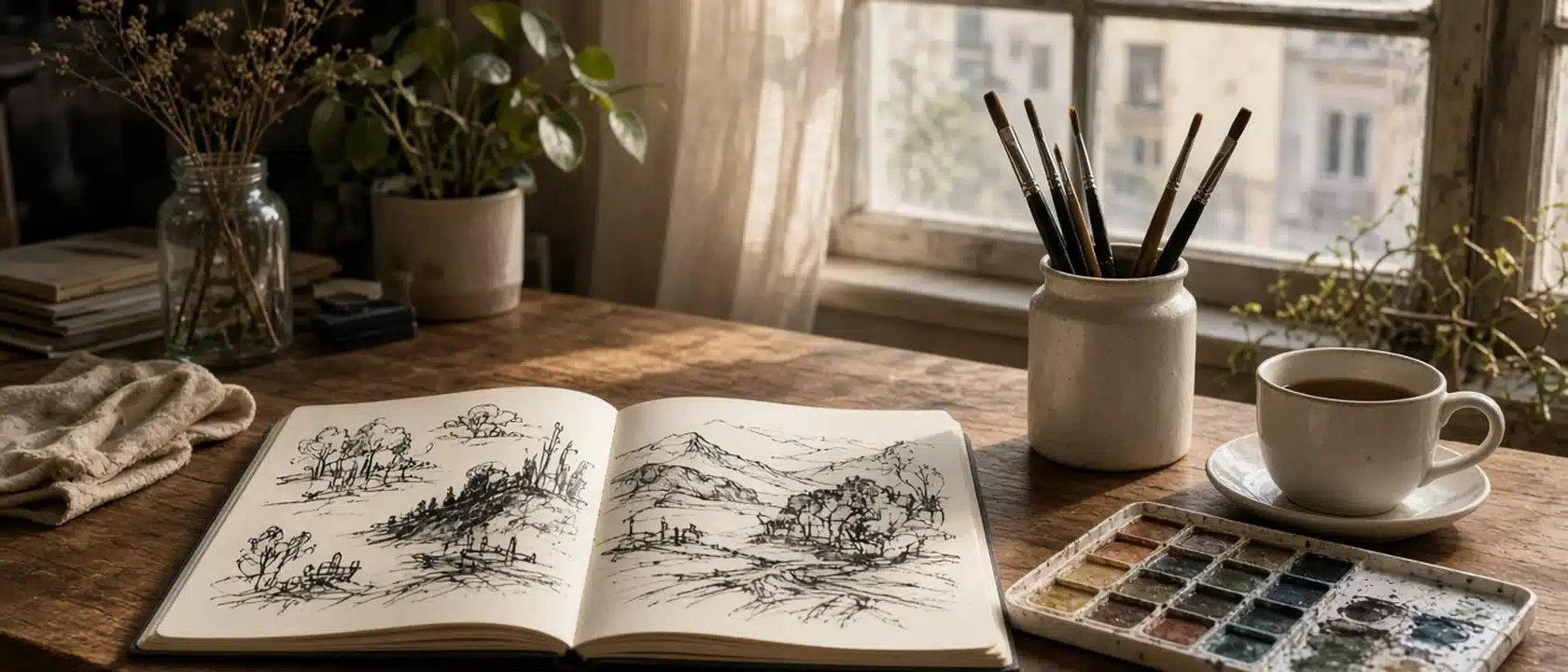
If you have ideas after a psychedelic experience, you’d be wise to capture them quickly. Write down what you saw and felt, make sketches, or record a voice memo. In the days that follow, you can take your time to process those impressions. Many artists describe this sober phase as the most important one. That’s when you decide what’s worth pursuing and what isn’t.
It also helps to keep your expectations low. Anyone who goes on a trip with the goal of creating a masterpiece will quickly become disappointed. Think of an experience more as a way to see things differently. You often don’t realize what comes out of it until later. Read more about how to make sense of an experience in our article on integration.
What Researchers Don't Know Yet
Many questions remain unanswered. Most studies are small and measure creativity using short tests in a lab. It is unclear what those tests reveal about actual creative achievements, such as writing a book or composing music. We also know little about long-term effects. In addition, study participants often know whether they have received the actual treatment. This makes it difficult to rule out the effect of expectation.
Creativity and Nature
A striking theme in many stories is the role of the environment. People who have had an experience in nature often describe a strong sense of connection. Research shows that even without any special tools, spending time in nature can help restore focus. A walk in the woods is therefore a simple and legal way to clear your head and make room for new ideas.
Being creative helps, too
There’s an interesting twist. Engaging in creative activities can itself help you process experiences. Drawing, writing, and making music give you a way to express feelings that are hard to put into words. Artistic therapy takes advantage of that. You don't have to be an artist to do it. It's about the process, not the end result.
If you want to see how your creativity develops, you can keep a simple journal. Every week, write down the ideas you had, what you created, and how you felt. After a few months, you’ll start to see patterns. You might notice that you’re especially creative after a good a good night's sleep or after a long walk. Insights like that are often more valuable than any other remedy.
More at Smartific
Magic truffles · Microdosing truffles · Magic Truffle Tea · Trip Stopper · Psychedelica
Frequently Asked Questions About Psychedelics and Creativity
Do psychedelics make you more creative?
Does microdosing boost creativity?
Why does a trip feel so inspiring?
Are psychedelics legal in the Netherlands?
Can I work effectively while traveling?
Important
This article is intended for informational purposes only. Smartific does not supply any products that violate Dutch law. If you have any doubts or need personal advice, always consult a doctor.