


December
Shamanita and the Fly Agaric: Everything You Need to Know in 2026
Updated on October 29, 2026 · Reading time: 8 minutes
Short answer: Shamanita was a brand name for dried fly agaric (Amanita muscaria) that used to be sold in smart shops. Since December 1, 2008, the fly agaric has been listed on Schedule II of the Opium Act. Its sale is therefore no longer permitted in the Netherlands. The mushroom contains substances that can be toxic.
Almost everyone is familiar with the red mushroom with white spots. It appears in fairy tale books, on Christmas cards, and in video games. Yet few people know that the fly agaric also has a long and remarkable history. For years, it was sold in “smart shops” under the name Shamanita. In this article, you’ll learn what Shamanita was, what the fly agaric is, what the law says, and why caution is important.
Table of Contents
What is Shamanita?
Shamanita was the trade name for dried fly agaric mushrooms that were sold in Dutch smart shops until 2008. The name is a combination of “shaman” and “Amanita,” the scientific genus name of the mushroom. The product usually consisted of dried fly agaric caps. Since the 2008 ban on magic mushrooms, it is no longer legally available for sale in the Netherlands.
Still, people are searching for Shamanita. This is due to the mushroom’s popularity and stories circulating online. In this article, we’ll give you the facts—without any preparation or usage instructions.
The fly agaric (Amanita muscaria)
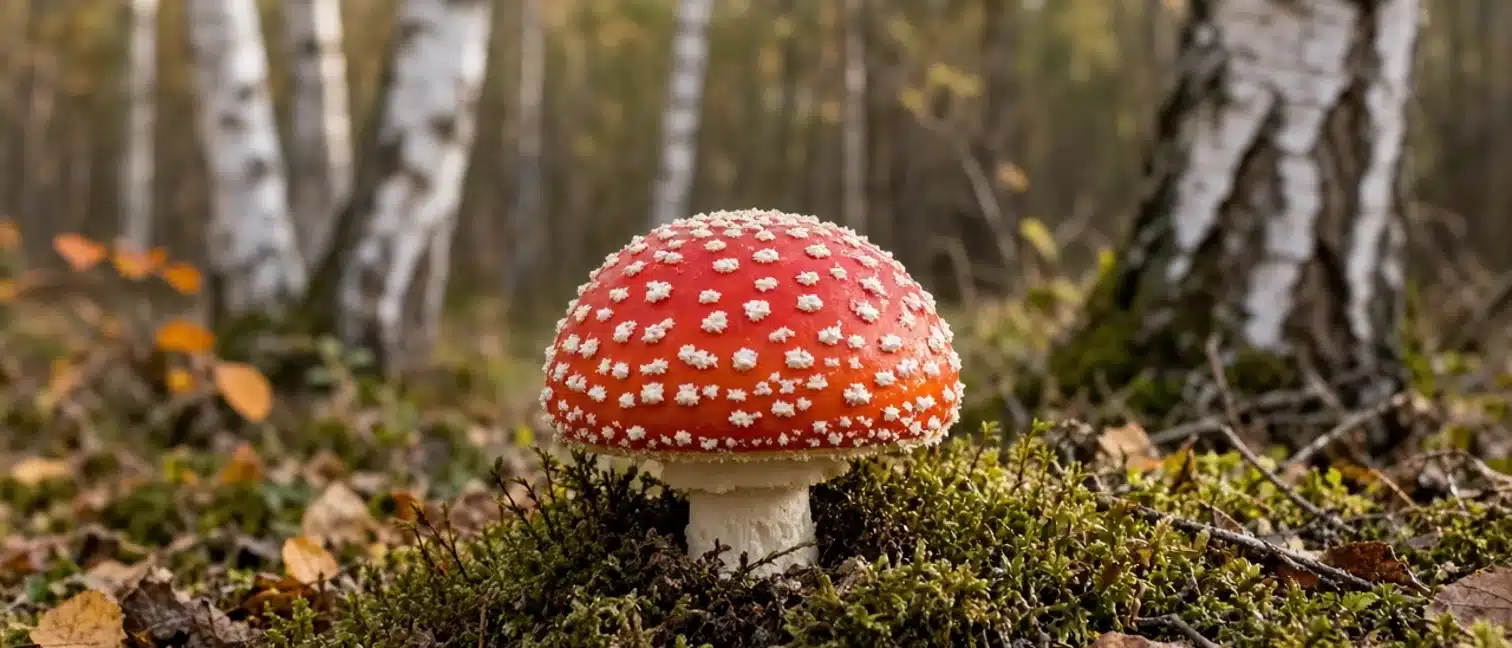
The fly agaric is a mushroom belonging to the Amanitaceae family. It grows in Europe, Asia, and North America and has also spread to other continents. It is most commonly found in the fall, from August through November. It lives in symbiosis with the roots of trees, especially birches and pines. This is called mycorrhiza. The tree and the mushroom exchange nutrients in this process.
Why is it called a fly agaric?
The name comes from an old custom. People would place pieces of the mushroom in a saucer of milk to attract and kill flies. This custom was described as early as the thirteenth century by the German scholar Albertus Magnus. The scientific name *muscaria* comes from the Latin word *musca*, which means “fly.”.
Confusion with other species
The fly agaric is related to some of the most poisonous mushrooms in the world. The death cap (Amanita phalloides) and the sticky death cap are life-threatening. The panther cap (Amanita pantherina) is also poisonous and, in some forms, resembles the death cap. Rain can wash away the white flakes on the cap, making the mushroom harder to identify. For this reason, mushroom experts advise against picking amanitas.
Please note Never eat a wild mushroom that you don’t recognize with certainty. Even experienced mushroom pickers can make mistakes. If you suspect poisoning, call 112 or your family doctor. Doctors can seek advice from the National Poison Information Center.
What ingredients are in it?
The fly agaric contains different substances than magic truffles. Truffles and magic mushrooms contain psilocybin. The fly agaric primarily contains ibotenic acid and muscimol. Ibotenic acid is an amino acid that is partially converted into muscimol in the body. Muscimol acts on the GABA receptors in the brain. This is a completely different mechanism than that of psilocybin. The levels of these compounds vary greatly depending on the mushroom, the location, and the season.
The name "muscarine" is derived from the fly agaric, because the substance was first isolated from it in 1869. It later turned out that the fly agaric contains only a small amount of it. Other mushrooms, such as some webcaps and funnel mushrooms, contain much more muscarine.
A Long History
The fly agaric has a rich cultural history. In Siberia in particular, the mushroom was used by peoples such as the Koryaks and the Khants. European travelers began describing this use as early as the 18th century. The Swedish officer Philip Johan von Strahlenberg wrote about it in 1730 in a book on Siberia.
In 1968, the American banker and amateur mycologist R. Gordon Wasson wrote the book *Soma, Divine Mushroom of Immortality*. In it, he argued that the soma mentioned in the ancient Indian Rigveda was the fly agaric. That theory has never been proven and is questioned by many researchers. Nevertheless, the book made the mushroom world-famous.
The fly agaric is probably the most famous mushroom in the world. It appears in fairy tales, art, and video games, from *Alice in Wonderland* to *Super Mario*.
Christmas and Folklore
In Germany, Austria, and Switzerland, the fly agaric is considered a symbol of good luck. You see it on Christmas cards and as Christmas decorations. Some authors draw a connection between the mushroom’s red and white colors and Santa Claus’s outfit. That, too, is a popular theory without any hard evidence.
What does the law say?
On December 1, 2008, the Netherlands added a list of mushrooms to Schedule II of the Opium Act. This ban prohibited both fresh and dried magic mushrooms. The fly agaric is also on this list. Since then, Shamanita may no longer be sold. Magic truffles are not covered by the ban, because they are not mushrooms but sclerotia. See also our article on The Risks of Magic Truffles.
Muscimol as a standalone substance is not listed in the Opium Act. However, it cannot simply be sold as a food product. In the EU, it is considered a novel food without approval. Therefore, products from other countries containing fly agaric extract—such as gummies—are also not permitted as food in the EU. The NVWA and other regulatory agencies warn against these products.
Other countries
In many other countries, the fly agaric is not banned. In the United States, many fly agaric gummies have been sold in recent years. The U.S. FDA has not approved muscimol as a food ingredient. Warnings were issued following reports of sick children and adults. Several U.S. states also took action. Do not bring such products into the Netherlands.
Risks
The fly agaric is poisonous. In the Netherlands, cases of poisoning mainly occur among people who mistake this mushroom for an edible species. Symptoms include nausea, vomiting, confusion, restlessness, and drowsiness. In rare cases, a person may lose consciousness. Because the concentration of active compounds varies so widely, it is impossible to predict how severely a person will react.
- ✓The content of these substances varies greatly from one mushroom to another.
- ✓There is a risk of mistaking them for deadly poisonous amanita mushrooms.
- ✓The effects are unpredictable and can last a long time.
- ✓Combining it with alcohol or other substances increases the risks.
- ✓Children and pets are particularly vulnerable.
Do you have a fly agaric in your yard, and do you have small children or a dog? If so, remove the mushroom while wearing gloves. Throw it away with the general waste.
Legal Alternatives
Are you interested in the world of mushrooms? There are plenty of legal ways to learn more about them. Join a field trip organized by a nature organization or a mushroom club. Consult a field guide or an app to identify mushrooms, but don’t rely blindly on an app. At Smartific, you’ll also find functional mushrooms such as lion's mane and Reishi. They do not contain any psychoactive substances.
The fly agaric in nature
The fly agaric plays an important role in nature. By symbiotically interacting with tree roots, it helps trees obtain water and minerals. In exchange, the mushroom receives sugars from the tree. What you see above ground is only the fruiting body. Most of the fungus lives as a network of threads in the soil. A young fly agaric emerges from the ground as a white ball. Then the sheath splits open and the cap turns red. The white dots are remnants of that sheath.
Many animals leave the fly agaric alone, but some insects and snails do eat it. Reindeer in Lapland are also mentioned in stories in connection with the mushroom. That connection has not been thoroughly studied. It is known, however, that the mushroom features in stories and songs in Sami culture.
In the Netherlands, the fly agaric is not on the Red List. It is fairly common, especially on sandy soils. You often see it in forests in the Veluwe, in Drenthe, and in Brabant. Leave it where it is so others can enjoy it too. Of course, you’re always welcome to take a photo. It often makes for beautiful pictures.
Want to learn more? Then check out our article on How Psychedelics Are Studied in Therapy.
More at Smartific
Magic truffles · Functional Mushrooms · Psychedelic herbs · Trip Stopper · Smartshop
Frequently Asked Questions About Shamanita
What is Shamanita?
Is Shamanita legal in the Netherlands?
Is the fly agaric poisonous?
Can I buy muscimol gummies?
What should I do in case of poisoning?
Important
This article is intended for informational purposes only. Smartific does not supply any products that violate Dutch law. If you have any doubts or need personal advice, always consult a doctor.