Free shipping over €125
 Discreetly packaged
 Track & Trace
 Secure Payment
 8.6/10 customer rating.








August
Buy CBD oil without haggling over the price
You grab a bottle of 5% and one of 20%. The second one is stronger, so it must be better, too. That makes sense. Just like four espressos would be better than one.
Who I want to buy CBD olie, you don't necessarily have to go for the highest percentage. Your choice mainly depends on the amount of CBD per serving, the type of extract, and the information on the label.
Table of Contents
A high percentage does not win a trophy
The percentage indicates the concentration of CBD. In a 10-ml bottle, 5% typically corresponds to 500 mg of CBD. A concentration of 10% in the same volume typically amounts to 1,000 mg.
That doesn't mean that 10% is twice as suitable for you. It just means that you're getting more CBD per milliliter. This is handy if you want to use less oil, but less so if you have trouble measuring out small amounts.
Think in terms of milligrams, not big numbers
Compare bottles based on the total number of milligrams of CBD. Then check how many milligrams are in a recommended serving. Counting only drops is less accurate, because droppers and liquids can vary.
Always check these amounts on the packaging. Manufacturers may use different bottle sizes or labeling. After all, a 30-ml bottle labeled 5% contains more CBD than a 10-ml bottle with the same percentage.
Here's how to compare two bottles fairly
- 1Record the volume in milliliters.
- 2Find the total number of milligrams of CBD.
- 3Check the amount per recommended serving.
- 4Compare the price per 100 mg of CBD.
- 5Only then should you look at the percentage.
To calculate the price per 100 mg, divide the retail price by the total number of milligrams in CBD. Then multiply the result by 100. That way, you won't be fooled by a large bottle, a big box, or empty promises.
Three entries, no automatic winner
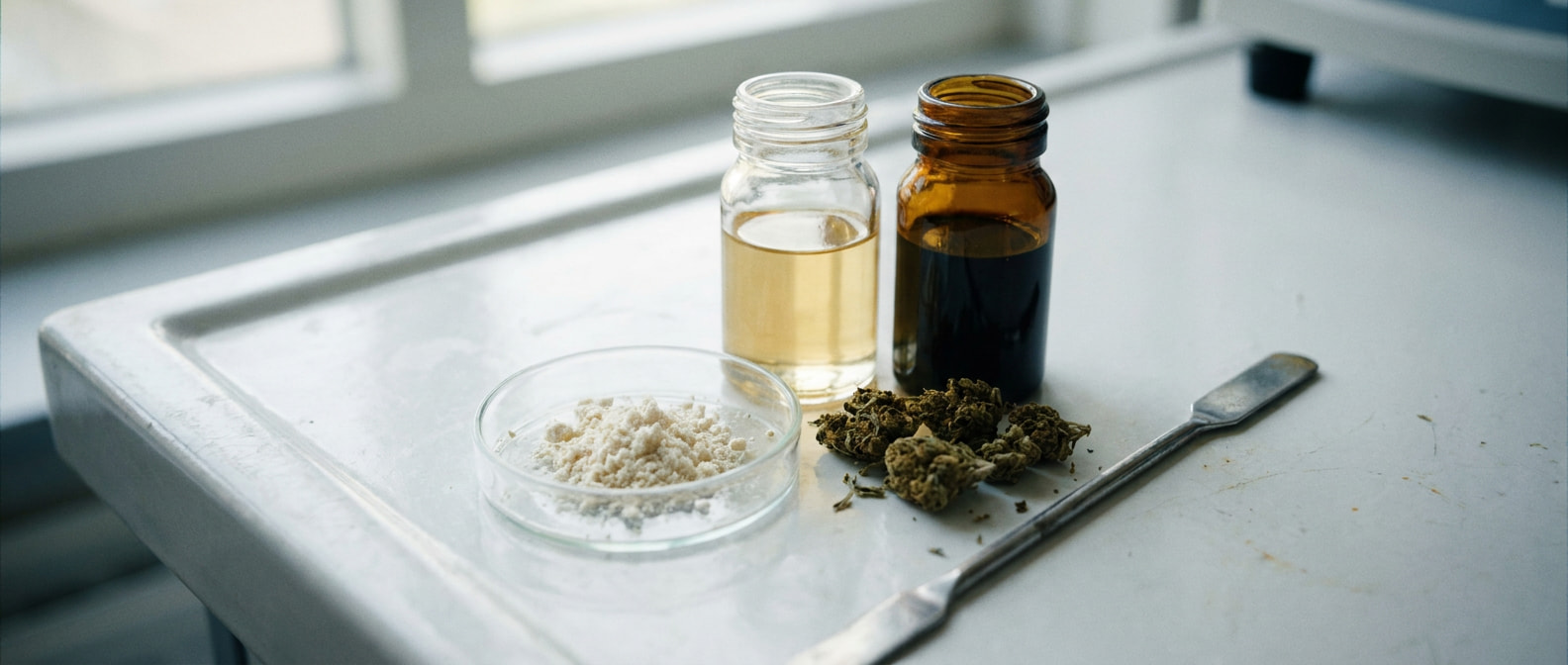
Labels often list the terms “full spectrum,” “broad spectrum,” and “isolate.” It sounds like you’re choosing an internet plan. It simply refers to the compounds found in the extract alongside CBD.
- ✓Full spectrum: Contains CBD and other naturally occurring plant compounds. Small amounts of THC may be present.
- ✓Broad spectrum: contains several cannabinoids and plant compounds, but is not supposed to contain any measurable THC.
- ✓CBD isolate: consists of isolated CBD added to a carrier oil.
Full-spectrum is suitable for someone who is consciously looking for a broader extract. Isolate has a simpler composition. Broad-spectrum falls somewhere in between, though a lab report is still needed to verify what was actually measured.
"THC-free" is not a magic spell
A claim such as “THC-free” sounds pretty definitive. However, laboratories work with detection limits. A result that is not detected above that limit does not always mean it is guaranteed to be zero.
That difference may be relevant if you’re sensitive to it, need to drive, or might have to take a drug test. CBD itself doesn’t produce a “high” like THC, but a full-spectrum product may contain traces of THC. You can read more about the distinction at Delta-8 THC and Delta-9 THC.
The label shouldn't be a scavenger hunt
A good label clearly tells you what you're buying. No jumble of botanical terms with a leaf on it and "good luck with that." If crucial information is missing, you can move on without feeling guilty.
Be sure to check at least the following items:
- ✓The bottle's volume in milliliters.
- ✓The total number of milligrams of CBD.
- ✓The concentration as a percentage.
- ✓The type of extract.
- ✓The carrier oil used.
- ✓A list of ingredients and a batch number.
- ✓Storage instructions and expiration date.
A batch report comes with your bottle
A certificate of analysis is often referred to as a COA. It lists the cannabinoids that a laboratory has measured in a batch. More detailed reports may also include results for, for example, heavy metals, pesticides, or solvent residues.
Check to see if the batch number on the report matches the bottle. Also make sure the product name and concentration are correct. A neat report for a different product is mostly just a nice decoration.
Just because a report can't be found doesn't automatically mean the product is bad. It does mean, however, that you have less control over it. That's no small matter when you're taking something.
The carrier oil counts too
CBD is usually mixed with a carrier oil, such as MCT oil or hemp seed oil. That oil affects the taste, among other things, and can be important in cases of allergies or sensitivities.
CBD oil is not the same as regular hemp seed oil. Hemp seed oil naturally contains almost no CBD. So just because a bottle has green packaging and the word “hemp” on it doesn’t mean it’s a CBD product. Otherwise, pesto would also be a cannabinoid.
Starting off slowly doesn't mean losing the game
There is no single dosage that works the same for every adult. Product strength, individual sensitivity, and other substance use all play a role. Therefore, start with the lowest dosage recommended by the manufacturer on the label.
Don't change the dosage right after every dose. Otherwise, you'll have a hard time figuring out what you're reacting to. Instead, keep track of how many milligrams you're taking, when you're taking them, and whether you notice anything unusual.
- 1Read the product instructions in their entirety.
- 2Calculate how many milligrams are in one serving.
- 3Start with the lowest recommended amount.
- 4Don't use it anymore because the effect isn't immediately noticeable.
- 5Stop if you get an unpleasant or unexpected response.
CBD oil is often applied under the tongue and then swallowed. However, always follow the instructions for the specific product. Using a different concentration without thinking, even with the same number of drops, is asking for trouble.
Side effects are not imaginary
CBD is not intoxicating like THC, but it’s not lemonade syrup either. Possible side effects include drowsiness, a dry mouth, gastrointestinal issues, and changes in appetite. Not everyone experiences these effects.
Do not drive or operate machinery if you are drowsy, dizzy, or less alert. Do not carelessly combine CBD with alcohol or other substances that affect your reaction time.
Medications make the math more serious

CBD may affect the way your body metabolizes certain medications. If you are taking prescription medication, it is advisable to consult a doctor or pharmacist before you start taking CBD. Never stop taking your medication on your own to make room for CBD.
Extra caution is advised during pregnancy, while breastfeeding, if you have a medical condition, or if you are planning a medical procedure. This information is intended for adults 18 years of age and older. It is not a substitute for personal medical advice.
Also, be wary of products that promise a cure, guaranteed sleep, or pain relief. CBD oil is not a proven miracle cure for a long list of ailments. A nice package can go a long way, but it can’t replace solid evidence.
Store without damaging the bottle
Close the bottle tightly after use. Store it according to the label, usually in a cool place away from direct sunlight. Avoid letting the pipette touch your mouth to prevent unnecessarily contaminating the contents.
- ✓Use a clean, dry pipette.
- ✓Check the smell and appearance.
- ✓Check the expiration date.
- ✓Keep out of the reach of children and pets.
- ✓Don't share your bottle with others without thinking.
If the oil suddenly smells strange, the packaging is damaged, or its appearance has changed for no apparent reason, do not continue using the product. Ask the seller for clarification or throw it away.
Buy control, not confetti
The right choice has a clearly specified amount of CBD, a verifiable composition, and a concentration that allows for precise use. A lower percentage can be useful for gradually building up your intake. A higher percentage can be practical if you want to consciously consume less oil.
For more background information, read on inside Marijuana. Curious about other topics and resources? Then check out all posts. That way, buying CBD olie remains a practical choice, rather than a game of percentage bingo.
FAQs About Buying CBD Oil
What percentage of CBD oil is suitable for a beginner?
+
What is the difference between 5%, 10%, and CBD oil?
+
Does CBD oil get you high?
+
Can you use CBD oil with medications?
+
How can you tell if CBD oil is reliable?
+
Important
This article is intended for informational purposes only. Smartific does not supply any products that violate Dutch law. If you have any doubts or need personal advice, always consult a doctor.