



September
How Do You Choose a Weed Grinder? Material, Chambers, and Size
Updated on October 29, 2026 · Reading time: 8 minutes
Short answer: Choose a good grinder based on material, number of parts, size, and teeth. Aluminum is the best all-around option: strong, lightweight, and affordable. A four-piece grinder comes with a sieve and a pollen catcher. Acrylic is inexpensive but wears out faster. Wood is attractive but harder to clean.
A grinder seems like a simple thing. Two toothed discs—turn it a few times, and you’re done. Yet there’s a big difference between a good grinder and a bad one. A good one grinds evenly, lasts for years, and runs smoothly. A bad one breaks, leaves behind metal shavings, or gets stuck.
In this article, you'll learn what to look for when choosing a grinder. We'll cover the material, the number of parts, the size, the teeth, and maintenance. This will help you find the grinder that suits your needs and budget.
Table of Contents
What does a grinder do?
A grinder grinds dried herbs into a uniform, loose texture. This is faster and cleaner than using your fingers or scissors. You handle the herbs less, so less resin sticks to your hands. What’s more, the result is more consistent. This ensures a smooth, even burn when rolling a joint. In a vaporizer, a consistent grind ensures better heat distribution.
A grinder consists of at least two parts with sharp teeth or pins. A magnet or screw thread holds them together. When you twist the parts together, the teeth tear the herbs into small pieces.
Choose the right material
Aluminum
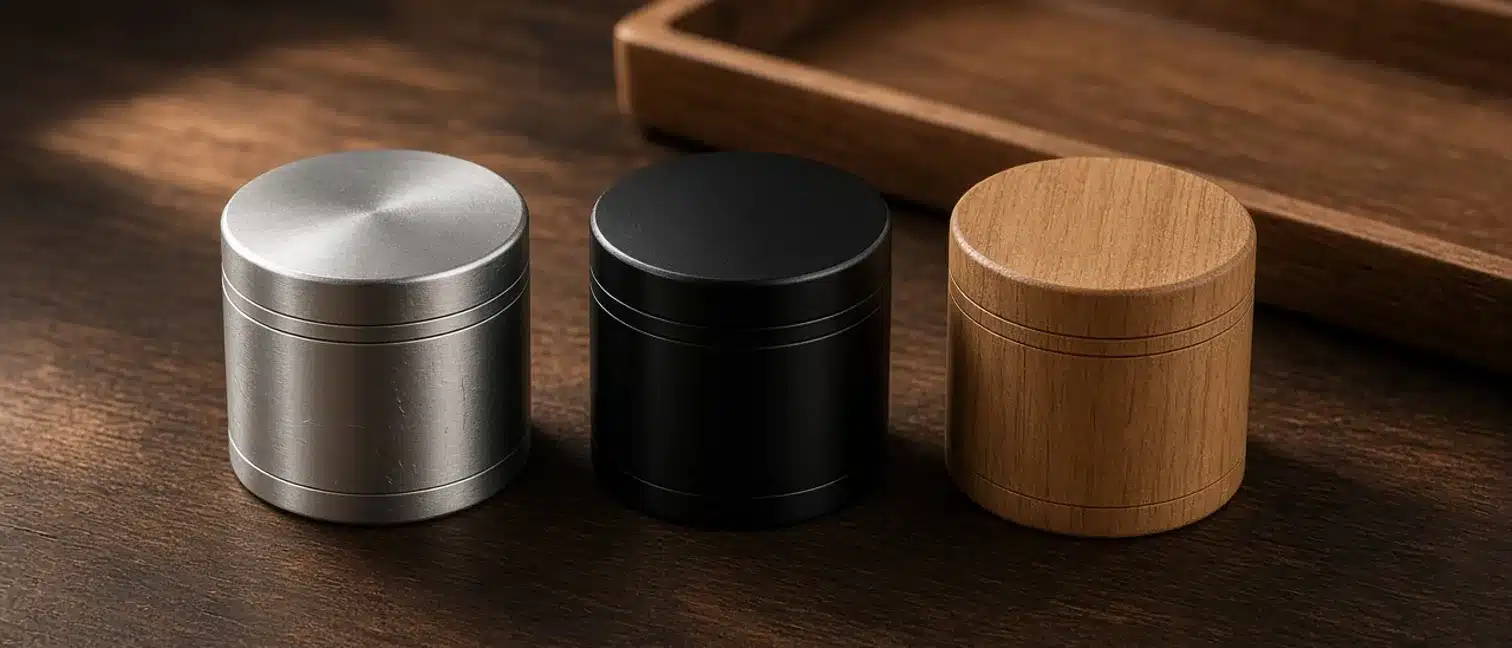
Most grinders are made of anodized aluminum. Anodizing is a treatment that hardens the metal and protects it from wear and tear. A good aluminum grinder has sharp, diamond-shaped teeth and turns smoothly. Pay attention to quality: with very cheap models, the metal can crumble. A grinder made of aircraft-grade aluminum, such as 6061 or 7075, is sturdier.
Acrylic
Acrylic grinders are inexpensive and come in a variety of colors. They’re handy as a spare grinder or for travel. The plastic isn’t as strong as metal. The teeth can break off, and the material becomes static. As a result, herbs stick to the sides.
Wood
Wooden grinders have a warm, natural look. They’re often made with pins instead of teeth. Wood is porous and absorbs odors and resin, which makes cleaning them with alcohol or water more difficult. For those who prefer a natural look, they’re a great choice.
Stainless steel and titanium
These grinders are the most expensive but also the most durable. The material is very hard, so the teeth stay sharp for a long time. No metal shavings are produced. If you’re looking for a grinder that will last for years, these are your best bet.
How many pieces do you need?
Grinders are sold in sets of two, three, four, or five parts. By "parts," we mean the individual components, including the lid. The more parts, the more functions.
A two-piece grinder is small and simple. A three-piece grinder is more convenient because the ground herbs fall into a separate container. The most popular choice is the four-piece grinder. It has a screen at the bottom that catches fine resin particles. That pollen is also known as jaw ... A five-part grinder is especially useful for those who want to separate the pollen as thoroughly as possible.
Not sure which one to choose? Then go for a four-piece aluminum grinder. For most people, that offers the best balance between price, ease of use, and durability.
Which size is right for you?
The size of a grinder is specified in millimeters of diameter. The most common sizes range from 40 to 63 millimeters.
- ✓About 40 mm: compact, fits in your pants pocket, handy when you're on the go.
- ✓Around 50 to 55 mm: the standard size for home use, enough for a few joints.
- ✓About 60 to 63 mm: large, for those who grind a lot at a time.
A larger grinder grinds faster, but isn't as easy to carry around. If you only want one, a medium-sized grinder of about 50 millimeters is usually the best choice.
Teeth and Grinding Quality
Also pay attention to the shape of the teeth. Diamond-shaped teeth cut sharply and provide an even grind. Round pins are gentler and are often found in wooden and inexpensive grinders. Some grinders have an adjustable coarseness setting. This lets you choose between a fine grind for a vaporizer and a coarser grind for a joint or pipe.
Also check the closure. A strong magnet keeps the lid securely in place. On grinders without a magnet, the lid is often secured with a screw thread. A Teflon or rubber ring between the parts ensures that it continues to turn smoothly.
Manual or electric?
An electric grinder uses a small motor and a blade or gear. You don’t have to apply any force. This is convenient for people with limited hand strength or for grinding larger quantities. The downsides are the price, the need to recharge it, and the lack of precise control over the grind size. For most users, a good hand grinder works just fine.
Cleaning Your Grinder
Over time, resin builds up on the teeth and the screen. The grinder then becomes harder to turn and doesn't grind as well. A metal grinder is easy to clean.
- 1Take all the parts apart and shake out any loose debris.
- 2Place the metal parts in a container filled with isopropyl alcohol.
- 3Let them soak for half an hour.
- 4Brush the teeth and the sieve with a soft toothbrush.
- 5Rinse everything with warm water and let it dry thoroughly.
For acrylic, it's best to use warm water and dish soap. Alcohol can make the plastic look dull. Clean wooden grinders only with a dry brush.
How much does a good grinder cost?
You can buy a simple acrylic grinder for just a few euros. A good four-piece aluminum grinder usually costs between 10 and 30 euros. You’ll pay more for grinders made of stainless steel, titanium, or from well-known brands. Electric grinders are also often in a higher price range. Investing in quality pays off: a good grinder will last for years.
Looking for more accessories? Check out our tips on the head shop or check out our rolling papers and rolling trays.
A grinder for on the go or for at home?
Do you mainly use your grinder at home? If so, it can be a bit bigger and heavier. A four-part grinder with a strong magnet and a spacious collection bowl is ideal in that case. For on the go, a small, lightweight grinder is more convenient. Make sure it has a lid that closes securely so nothing ends up in your bag.
That's why some people have two grinders: a sturdy one for home and a compact one for when they're on the go. A card grinder—a flat piece of metal with holes in it—is an alternative for travel. It fits in your wallet, but it doesn't work as well.
Common Mistakes
- ✓Overfilling the grinder, causing it to jam.
- ✓Grinding herbs that are too wet causes the teeth to become dirty quickly.
- ✓Never clean it, which makes it hard to turn.
- ✓Buy a cheap metal grinder that sheds metal particles.
- ✓Clean the sieve with hard objects, causing it to tear.
Place a few large pieces between the teeth, not in the center. The magnet or shaft is often located in the center, where grinding is less effective. Turn it back and forth a few times, then gently tap the grinder. This will allow everything to fall into the collection tray.
Store your grinder in a dry place. This will keep the metal looking good and prevent the screen from rusting.
Does the magnet lose its pull after a few years, or is the screw thread worn out? If so, it's time for a new grinder. Replacement parts are usually not sold separately.
Want to learn more? Then check out our articles on What CBD Is and What the Law Says en Famous athletes who sometimes smoke weed.
Grinders and Accessories at Smartific
All grinders · 4-piece grinders · 2-piece grinders · Acrylic grinders · Rolling trays
Frequently Asked Questions About Grinders
Which grinder is the best?
What is the difference between a 3-piece and a 4-piece grinder?
How do I clean my grinder?
What size grinder do I need?
Is an electric grinder better?
Important
This article is intended for informational purposes only. Smartific does not supply any products that violate Dutch law. If you have any doubts or need personal advice, always consult a doctor.