



September
What Makes Cannabis Seeds High-Quality? How to Identify, Choose, and Store Them
Updated on October 29, 2026 · Reading time: 9 minutes
Short answer: Good cannabis seeds are ripe, firm, and undamaged. They are usually brown or gray in color with dark markings. Green, white, or soft seeds are often unripe. Stable genetics from a reliable seed bank are just as important. Store seeds in a dark, cool, and dry place. Seeds are legally available for purchase in the Netherlands.
Anyone who buys cannabis seeds wants to know if they're good. But you can't tell everything just by looking at them. Two seeds can look the same but still be very different. So what determines their quality?
In this article, you’ll learn what to look for when evaluating seeds. We’ll discuss appearance, maturity, genetics, and the different types of seeds. You’ll also learn how to store seeds and what Dutch law says about them.
Table of Contents
What is a cannabis seed?
A cannabis seed is the seed of the cannabis plant (Cannabis sativa L.). Botanically speaking, it is a nut with a hard shell. Inside that shell is the embryo of a new plant, along with a small supply of nutrients. A seed is formed when a female plant is pollinated by a male plant.
The seed itself does not contain any significant amount of THC. That is also why hemp seeds are sold as a food product. Read more about the difference between hemp oil and CBD olie.
Physical Characteristics of a Good Seed
Color
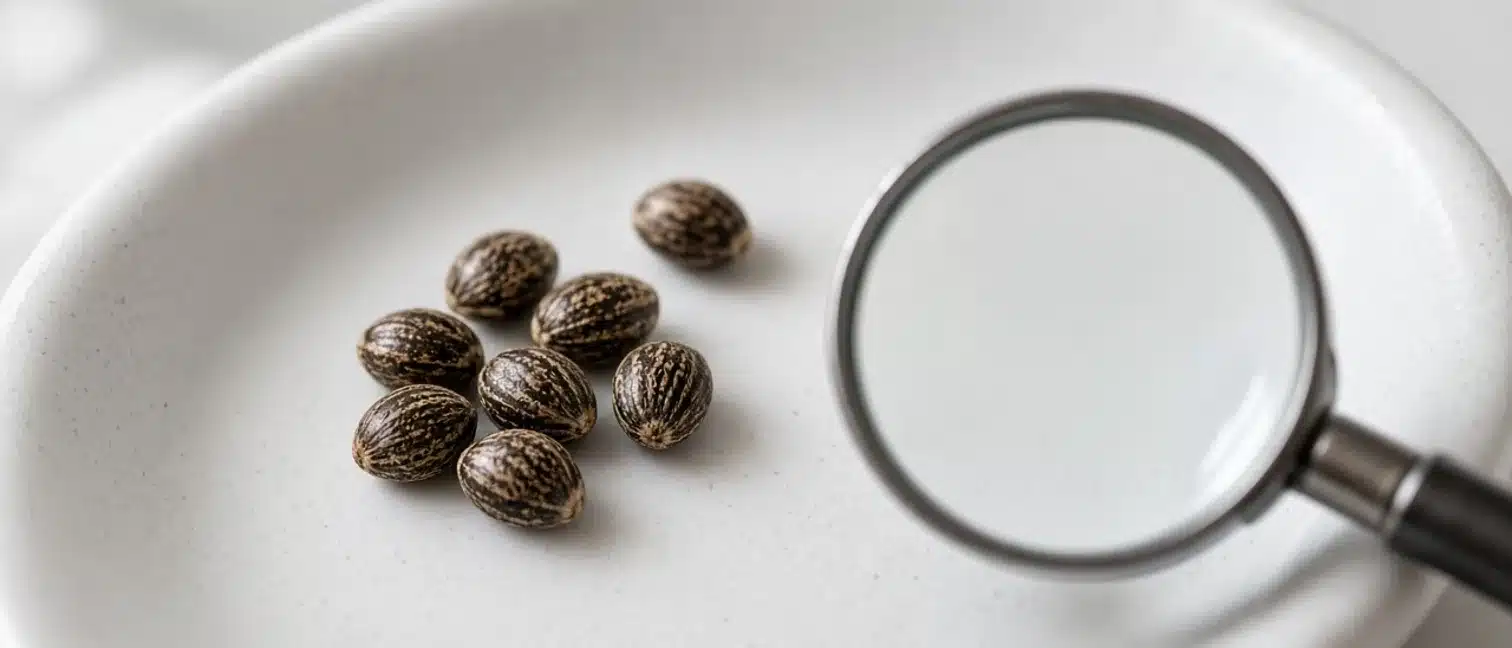
Ripe seeds are usually brown, gray, or dark with a pattern. This pattern is also known as tiger stripes or marbling. Not every good seed has these stripes. Light green or white seeds are often picked from the plant too early and are therefore unripe.
Hardness
A good seed feels firm to the touch. If you gently squeeze it between your thumb and index finger, it won’t give way. Seeds that are soft, squishy, or crumbly are often too old or have been stored improperly. Don’t press too hard, because you could damage a good seed.
Peel and Shape
The shell should be intact, without any cracks or holes. A smooth, slightly shiny shell indicates a healthy seed. Flat, shriveled, or misshapen seeds are less reliable. Size is not a reliable indicator. Some varieties naturally have small seeds.
Appearance tells us something about the seed's maturity and health. It tells us nothing about its genetics.
Genetics: The Invisible Aspect of Quality
A plant's characteristics are encoded in the seed's DNA. Consider its growth habit, smell and taste. A seed can look perfect and still come from an unstable cross. In that case, plants from the same packet can vary greatly from one another.
Reputable seed banks spend years developing stable strains. They select parent plants and test their offspring. That’s why a seed bank’s reputation is often the best guide. Well-known Dutch strains include Sensi Seeds from 1985 and Dutch Passion from 1987.
Types of Seeds
Regular
Regular seeds are the result of a standard cross between a male and a female plant. About half will develop into male plants and half into female plants. Breeders use regular seeds to create new crosses.
Feminized
Feminized seeds are bred so that virtually all plants will be female. This is achieved by inducing a female plant to produce its own pollen, for example, using silver thiosulfate. Feminized seeds are the best-selling type today. See also our feminized weed seeds.
Autoflowering
Autoflowering seeds contain genes from Cannabis ruderalis, a subspecies native to Central Asia and Eastern Europe. These plants begin to flower based on age rather than day length. Check out the autoflowering cannabis seeds.
How can you tell if a sperm bank is reliable?
- ✓Clear information about a species' origin and parents.
- ✓Original, sealed packaging.
- ✓A dedicated customer service team and contact information.
- ✓A long history and good reviews.
- ✓No unrealistic promises.
It's best not to buy loose seeds of unknown origin. You won't know how old they are or how they were stored.
Storing Seeds
Seeds are living organisms. Even when dormant, they slowly use up their reserves. The better you store them, the longer they’ll stay fresh. The three rules are: dark, cool, and dry. A temperature between 6 and 8 degrees Celsius is ideal. That’s why many people store seeds in a sealed container at the back of the refrigerator. If necessary, add a packet of silica gel to absorb moisture.
Don't keep taking the seeds out of the refrigerator. Temperature fluctuations cause condensation. Properly stored seeds often stay good for several years. At room temperature, their quality deteriorates more quickly. See also our article on Storing Herbs.
What does Dutch law say?
Cannabis seeds are not listed in the Opium Act. The sale and possession of seeds are therefore permitted in the Netherlands. However, growing cannabis is a criminal offense under the Opium Act. Since 2015, preparing for or facilitating commercial cultivation has also been a criminal offense under Article 11a. As a general rule, the Public Prosecutor’s Office does not prosecute individuals who grow up to five plants for personal use. This is a policy of tolerance and not a legal right. The municipality or housing authority may, however, take measures, such as cutting off electricity or terminating a lease.
Please note Laws vary by country. In many countries, the possession or shipment of seeds is also prohibited. Always check the laws of the country where you live.
In a nutshell
A good seed is ripe, firm, and undamaged. Its appearance tells you a lot, but not everything. The genetics and the reliability of the seed bank are just as important. Store seeds in a dark, cool, and dry place.
Why Maturity Is So Important
A seed matures inside the flower of the mother plant. During this period, it fills with reserve nutrients and its shell hardens. If the plant is harvested too early, the seed is not yet ready. The embryo is not yet fully developed, and the nutrient reserves are insufficient. Such a seed often remains light in color and feels soft to the touch.
Professional seed banks therefore allow the seeds to fully mature before harvesting them. They are then dried, sorted, and inspected. Small, light, or damaged seeds are removed. That is one of the reasons why seeds from well-known seed banks cost more than individual seeds of unknown origin.
Age of Seeds
Seeds don’t get better with age. The older a seed is, the greater the chance that it’s no longer viable. Properly stored seeds often remain viable for a few years, but their quality slowly declines. When purchasing, you may want to ask about the harvest date. Reliable seed banks regularly replenish their stock.
Common Misconceptions
- ✓Large seeds aren't necessarily better than small ones.
- ✓Tiger stripes are a good sign, but not required.
- ✓An expensive seed isn't necessarily a good seed.
- ✓Seeds from a bag of marijuana are often immature or of unknown genetics.
- ✓A beautiful name says nothing about a species' stability.
Seeds that you happen to find in cannabis are usually the result of unwanted pollination. In such cases, the genetics are unknown. Often, the mother plant has become stressed, which increases the likelihood that the offspring will exhibit both male and female traits.
Buying Seeds: What Should You Look For?
Buy seeds from an online store or retailer that clearly indicates which seed bank produced the seeds. Original packaging with a seal ensures that the seeds have not been tampered with. Read the product information carefully. A reliable seller will specify the seed type, the parents of the variety, and the seed bank. If that information is missing, it’s best to choose a different seller.
After purchasing, keep the packaging that lists the species name. That way, you'll know exactly what you have later on. Never mix seeds from different species in the same container.
Are you unsure about a strain or a seed bank? Ask for advice in the store or from customer service. A good salesperson will honestly explain the differences between strains and seed banks. They’ll also help you choose between regular, feminized, and autoflowering strains. That way, you’ll know exactly what you’re buying and why.
The packaging itself also says something about quality. Seeds should be in sturdy, sealed packaging that protects them from pressure, light, and moisture. Loose seeds in an unprotected envelope are more likely to be damaged during shipping.
Want to learn more? Then check out our articles on Cannabidiol Explained en What exactly is HHC?.
More at Smartific
Marijuana seeds · Feminized weed seeds · Autoflowering cannabis seeds · Head shop · CBD products
Frequently Asked Questions About the Quality of Cannabis Seeds
How can I tell if a cannabis seed is good?
Are green seeds bad for you?
How do I store cannabis seeds?
Is it legal to buy cannabis seeds in the Netherlands?
What is the difference between feminized and autoflowering?
Important
This article is intended for informational purposes only. Smartific does not supply any products that violate Dutch law. If you have any doubts or need personal advice, always consult a doctor.