


July
The Life Cycle of Magic Mushrooms: From Spore to Mushroom
Updated on October 29, 2026 · Reading time: 9 minutes
Short answer: A magic mushroom starts out as a spore. It germinates into thin threads called hyphae. Two compatible hyphae join together to form mycelium. This network grows through the growth medium. At the right temperature and humidity, pinheads form. These develop into mushrooms, which in turn release spores. With a magic mushroom Seed kit you'll skip the tricky first steps.
Mushrooms are fascinating organisms. What you see in the forest is just the tip of a vast underground network. Anyone who understands how that network works will see the mushrooms in the forest in a whole new light.
In this article, we’ll take you through the life cycle of magic mushrooms. You’ll learn what happens at each stage. You’ll also find out where psilocybin is found and what Dutch law says about magic mushrooms and grow kits.
Table of Contents
What are magic mushrooms?
Magic mushrooms are mushrooms that contain psilocybin. The best-known species is Psilocybe cubensis. There are more than a hundred species that produce this substance. They grow on every continent except Antarctica.
A mushroom is the fruiting body of a fungus. You can compare it to an apple on a tree. The actual fungus is found in the soil or in wood. It’s called mycelium. The fruiting body exists solely to spread spores.
Phase 1: the spore
It all starts with a spore. Spores are tiny. You can only see them when there are thousands of them together. Underneath a mushroom are gills. That’s where the spores are produced. A single mushroom can release millions of spores. The wind and animals spread them.
Spores are very resilient. They can survive for a long time until they find a suitable place to grow. Psilocybin is not present in spores. That is why spores are sold in the Netherlands for microscopic examination. Check out our selection at mushroom shop.
Phase 2: Spores and Hyphae
If a spore lands in a moist place with food, it will germinate. A thin thread will grow from it. This is called a hypha. A hypha is only one cell thick. It grows from the tip and branches out.
A hypha from a single spore cannot produce mushrooms on its own. To do so, it must encounter a compatible hypha from another spore. The two fuse together. Only then does mycelium form that can produce fruiting bodies.
Phase 3: mycelium
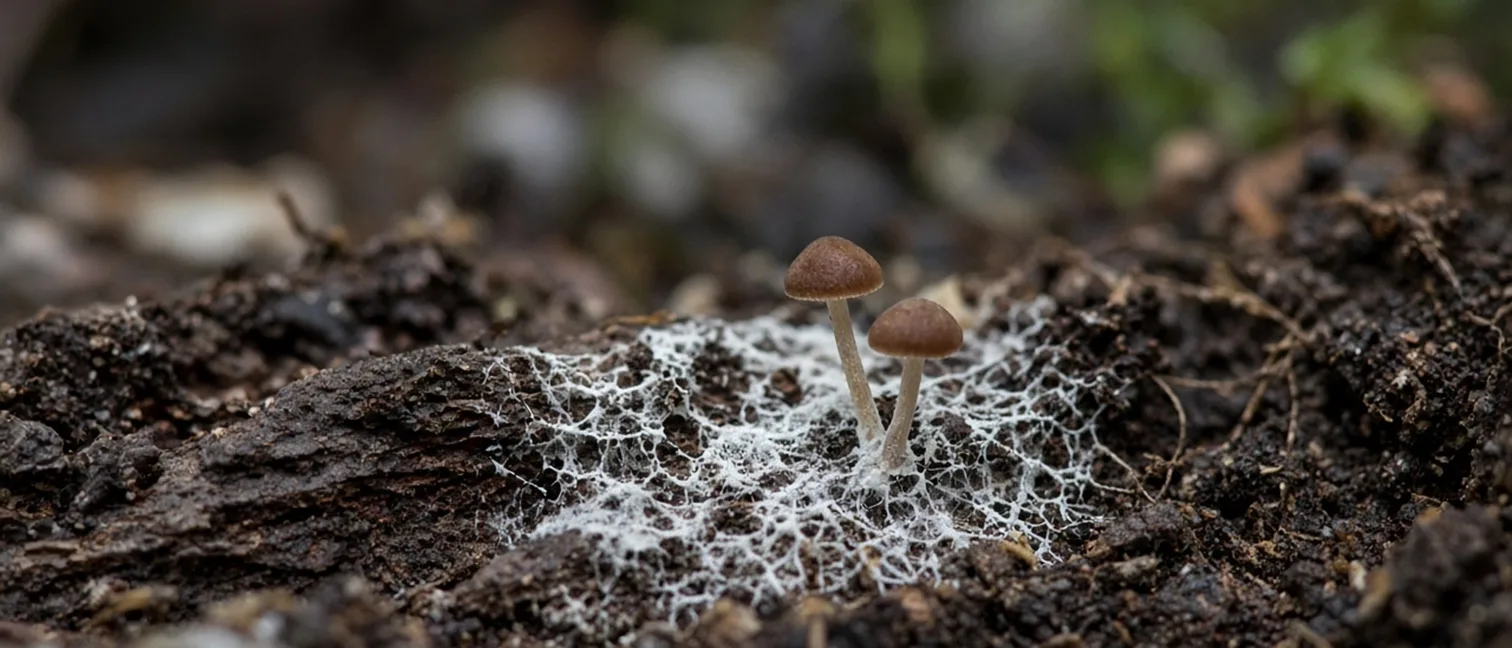
Mycelium is a white network of hyphae. It grows through the growing medium and breaks it down. This is how it obtains nutrients. In nature, this medium consists, for example, of manure or rotting wood. In a grow kit, it is usually a mixture of grain and other nutrients.
Healthy mycelium is bright white and dense. Green, black, or pink spots often indicate a fungal or bacterial infection. In nature, fungi and bacteria are constantly competing for the same nutrient source.
Sclerotia: A Side Path
Some species also form hard nodules made of mycelium. These are called sclerotia. They serve as a food reserve for lean times. You may know these nodules as magic truffles. Read more in our article about The Difference Between Truffles and Magic Mushrooms.
Phase 4: Pinheads
Has the substrate been completely colonized? If so, the mycelium can move on to the next phase. This happens when conditions change—such as more fresh air, some light, high humidity, and a slightly lower temperature. Small buds then appear on the surface; these are called pinheads.
Not every pinhead grows into a mushroom. The mycelium decides for itself which ones get the most nutrients. A few days after the first pinheads appear, you can tell which ones will become mushrooms.
Phase 5: The Mushroom
A pinhead quickly grows into a mushroom with a stem and a cap. This happens within a few days. The cap is initially closed. There is a thin membrane underneath the cap. When that membrane tears, the mushroom is fully grown. After that, the gills begin to release spores. Then the cycle is complete.
What is a magic mushroom grow kit?
A magic mushroom grow kit is a container filled with growing medium that has already been completely colonized by mycelium in a lab. The first stages of the life cycle have already taken place. Kweeksets and spores do not contain any mushrooms themselves and are legally available for purchase in the Netherlands.
We have deliberately chosen not to include growing instructions in this article. Each kit comes with a manual from the manufacturer. Do you have questions about a kit? Please contact our customer service.
Our magic mushroom grow kits include strains such as Golden Teacher, B+, Mazatapec, and McKennaii. Each strain has its own characteristics, such as the color of the cap and the size of the mushrooms.
Where is psilocybin found?
Psilocybin is the best-known substance in magic mushrooms. Swiss chemist Albert Hofmann isolated the substance from the Psilocybe mexicana mushroom in 1958. A year later, he also described its structure. In the body, psilocybin is converted into psilocin. That compound is responsible for the psychedelic effects.
Psilocybin is found in the mycelium, in the sclerotia, and in the mushroom itself. Spores do not contain the substance. The blue discoloration that you sometimes see when a magic mushroom is damaged occurs because psilocin reacts with oxygen. So it’s usually not a sign of mold.
The content varies by species and even by individual mushroom. That’s why it’s impossible to predict the potency of magic mushrooms with any precision. Read more about the proper dosage before using a product.
A mushroom is just the fleeting tip of a vast underground network. The mycelium is the actual organism.
What does the law say?
Fresh and dried magic mushrooms have been listed on Schedule II of the Opium Act since December 1, 2008. Kweeksets and spores do not contain mushrooms. They are available for purchase in the Netherlands. However, the mushrooms that grow from a kit are classified under Schedule II. Therefore, please also read our article about the correct dosage and place a Trip Stopper Done.
Mushrooms in Nature
Fungi play a major role in nature. They break down dead material and make nutrients available again. Many trees form symbiotic relationships with fungi through their roots. In the Netherlands, the pointed bald cap mushroom grows in the wild. It also contains psilocybin. Never pick wild mushrooms to eat. There are poisonous species that look very similar.
Mushrooms and the Environment
Researchers are increasingly looking to mycelium as a sustainable material. It is used to make packaging and building materials. Fungi can also help clean up contaminated soil. So the life cycle you see in a grow kit is part of a much bigger story.
How do you identify the different species?
Most of the species in cultivation kits are variants of Psilocybe cubensis. They look similar, with brown or golden caps. The differences lie in their size, color, and growth rate. Golden Teacher has a golden cap. B+ often produces large mushrooms. Hawaiian Copelandia is another strain that requires warmth.
Want to learn more? Then check out our articles on the PF Tek method en Making and Choosing Truffle Tea.
Kweeksets and Truffles at Smartific
Magic truffles · Trip Stopper · Mushroom grow kits · Microdosing truffles · Paddo dosage calculator
Frequently Asked Questions About the Life Cycle of Magic Mushrooms
What are the stages in the life cycle of a magic mushroom?
What is mycelium?
How long does it take for a magic mushroom grow kit to produce mushrooms?
Are grow kits legal in the Netherlands?
Important
This article is intended for informational purposes only. Smartific does not supply any products that violate Dutch law. If you have any doubts or need personal advice, always consult a doctor.